
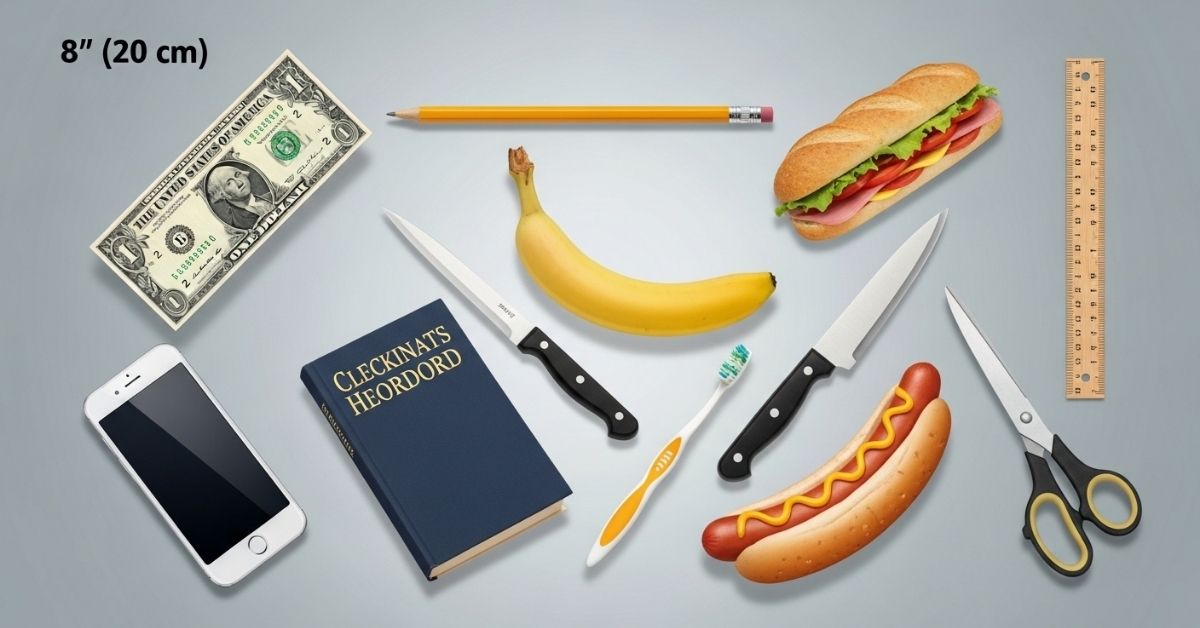
11 Common Things That Are 8 Inches Long
Ever grabbed something off the counter and thought, “how long is that, actually?” You’re not alone. Most people don’t walk around with a tape measure in their pocket. But here’s the thing, you probably already have a dozen measuring tools within arm’s reach. You just don’t know it yet.
Eight inches is one of those lengths that pops up everywhere. It’s not too short, not too long. It’s that sweet spot where so many everyday objects naturally land. Once you start noticing, you genuinely can’t stop. So let’s walk through 11 common things that are 8 inches long and explore why this length shows up more than you’d expect.
| Item | Approximate Length | Best Used For |
| Standard pencil | 7.5 to 8 inches | Quick desk measuring |
| Medium banana | 7 to 8 inches | Kitchen estimation |
| Two popsicle sticks | 8 inches | Crafting and DIY |
| Chef’s kitchen knife | 8 inches | Food prep reference |
| iPad Mini screen | 8.3 inches | Tech layout planning |
| Stretched male hand | 7.6 inches | On-the-go measuring |
| Two palms together | Around 8 inches | Body-based measurement |
| Eight US quarters stacked | 8 inches | Coin-based ruler trick |
| Three soda cans stacked | 8 inches | Visual size reference |
| Small hockey stick blade | 8 inches | Sports gear comparison |
| Baseball bat grip | 8 inches | Handle sizing guide |
Kitchen Heroes: Measuring Without a Ruler
Picture this. You’re in the middle of prepping dinner and you need to cut something to a specific size. The drawer is a mess, the ruler is nowhere. Sound familiar? This is where your kitchen quietly saves the day.
A standard chef’s knife runs right around 8 inches. That blade you use every single day is basically a ruler hiding in plain sight. A medium banana sits comfortably in that 7 to 8 inch range too. Weird? A little. Useful? Absolutely.
Two popsicle sticks laid end to end give you a clean 8 inches as well. Keep a couple in your junk drawer and you’ve got yourself a low-tech measuring hack that works surprisingly well. And your pencil, yes, that half-chewed one sitting by the notepad, comes in at around 7.5 to 8 inches. It’s one of the most underrated everyday measurement tools in any home.
These kitchen measurement hacks aren’t just fun trivia. They’re genuinely practical. When precision isn’t critical, like eyeballing the size of a serving or checking if a dish fits a shelf, these objects do the job without any fuss.
Read More: 14 Common Things That Are 2 Inches Long
Office & Study Life: When Your Desk is a Measuring Playground
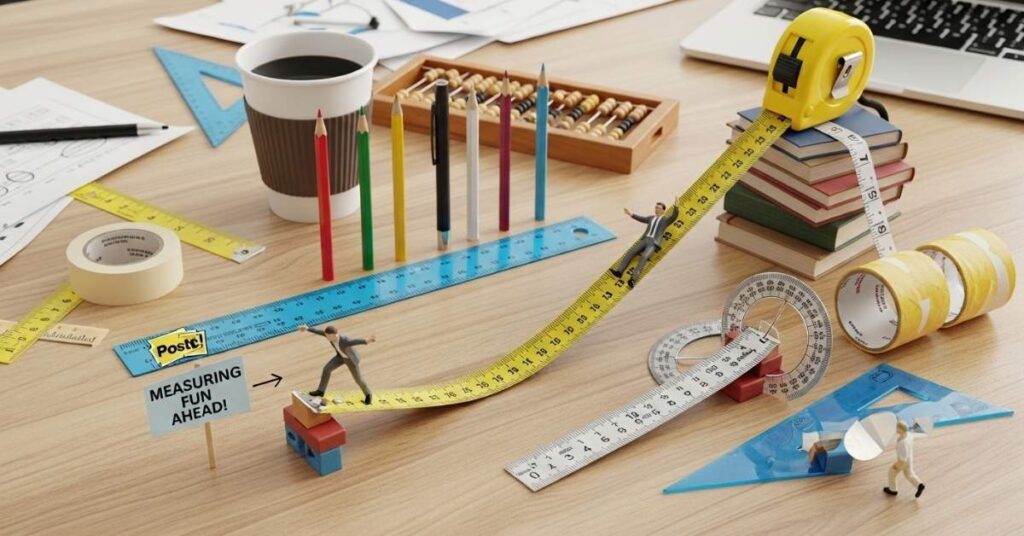
Your desk is basically a measurement lab and you’ve never even noticed. Everything sitting on it has a size, and a surprising number of those sizes cluster around 8 inches.
The iPad Mini screen measures about 8.3 inches diagonally. That’s close enough to serve as a visual size reference when you’re planning layouts or sketching ideas. A standard pencil makes another appearance here because, honestly, pencils are everywhere and they work.
Your stretched hand, from the tip of your pinky to the end of your thumb, averages around 7.6 inches for most adults. That’s a built-in ruler you carry absolutely everywhere. A small notebook or notepad can also hover near the 8-inch mark depending on the brand, making it useful for quick size comparison techniques when you’re deep in a project.
These ruler alternatives at home and at your desk aren’t just novelty ideas. They build a habit of spatial awareness that actually sharpens over time.
Sports Gear: Measuring in Motion
Sports equipment is designed with precision. What most people don’t realize is that some of that precision puts gear squarely in the 8-inch zone.
A small hockey stick blade often measures right around 8 inches. It’s a detail most players never think about, but coaches and gear modifiers definitely do. The grip section of a standard baseball bat also lands near 8 inches, which is why it feels so natural in an adult hand.
Some adult tennis racket handles hover close to this length too. Even certain lacrosse stick grips match up. If you’ve ever tried crafting a custom handle or grip for a piece of sports gear, knowing these approximate length objects gives you a genuine head start without needing calipers or measuring tape.
There’s something satisfying about realizing your sports bag is secretly full of portable measuring methods. It changes how you look at the gear entirely.
Household Measuring Tools: Coins, Hands, and Cans
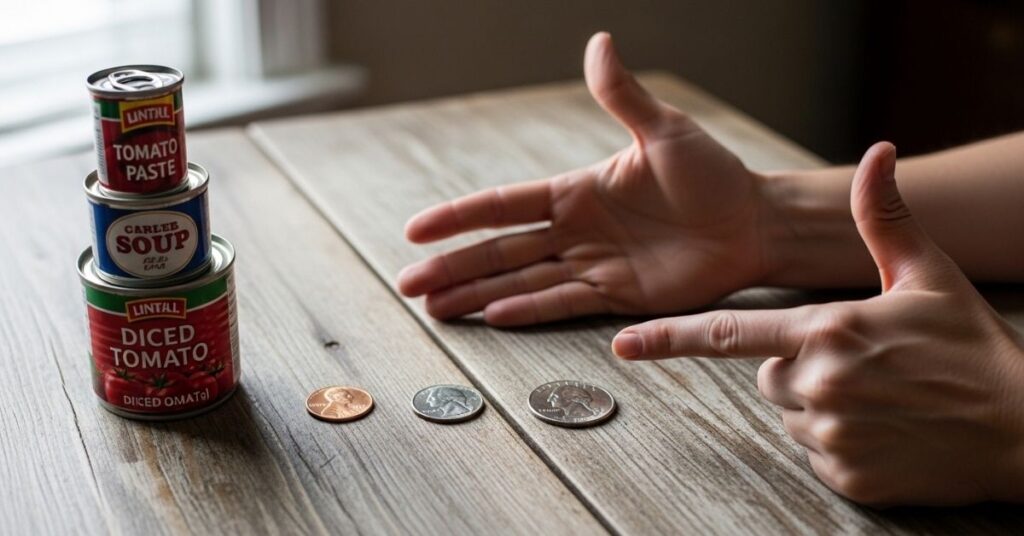
This is where things get genuinely clever. Everyday objects you’d never think twice about turn out to be shockingly reliable for common household measurements.
Start with US quarters. Each one is exactly 1 inch in diameter. Stack eight of them and you’ve got yourself a perfect 8-inch column. It’s one of the cleanest quick measuring tricks you can pull off anywhere.
Three standard soda cans placed end to end also hit 8 inches. Not the most elegant solution, but it’s visual, it’s memorable, and it works. A small cardboard box often measures 8 inches along one edge too, which makes it useful for storage planning and spatial organization tips around the home.
Here’s a quick breakdown of coin and can methods:
- 8 US quarters stacked vertically = 8 inches
- 3 soda cans placed end to end = 8 inches
- 2 standard popsicle sticks = 8 inches
- 1 chef’s knife blade = approximately 8 inches
These visual measurement methods aren’t replacements for a tape measure when you need exact numbers. But for rough estimation? They’re surprisingly solid.
Everyday Body Part References: Hands, Palms, Fingers
Humans have been using body parts for measurement since long before rulers existed. And honestly, it still works.
Your fully stretched hand, from thumb tip to pinky tip, averages around 7.6 inches. Close enough to 8 inches that it functions as a reliable quick reference. Two palms placed side by side land at approximately 8 inches for most adults. That’s your built-in, always-available, never-lost-in-a-drawer measuring tool.
Hand span measurement is one of the oldest estimation techniques around. It’s been used in carpentry, tailoring, and cooking across cultures for centuries. Your thumb, from tip to the first knuckle, is roughly 1 inch. So you can actually scale up from there for finer measurements.
These body-based measurement methods are especially great for teaching kids. Ask a child to measure something with their palms and suddenly measurement becomes tactile, fun, and memorable. It’s practical measurement in action without the intimidation of tools or numbers.
Fun Comparisons: How Random Things Measure Up
Here’s where size comparison techniques get genuinely entertaining. Think about a pencil versus a banana. A pencil runs 7.5 to 8 inches. A banana sits at 7 to 8 inches. They’re basically the same length. That’s either deeply satisfying or mildly unsettling depending on your personality.
Two popsicle sticks equal one chef’s knife in length. Eight quarters stacked equal three soda cans end to end. All of them land at 8 inches. There’s a strange elegance to how these unrelated objects align around a single measurement.
This kind of thinking trains your brain in estimation techniques without any effort. Once you make these comparisons a few times, your ability to guess dimensions quickly becomes genuinely sharp. You start seeing real-life size references everywhere, and that’s a surprisingly useful skill in daily life.
Creative Uses in Crafting and DIY
Knowing your things that are 8 inches long opens up a world of creative shortcuts for crafting and DIY projects.
Use a pencil as a quick spacer or ruler substitute when cutting fabric or paper. Two popsicle sticks taped together give you a clean, flat 8-inch measuring edge. Soda cans work as consistent spacers when building shelving or arranging items with even gaps. A medium banana can mock up curved shapes in prototyping, which sounds bizarre but works in a pinch.
These crafting measurement tools aren’t precise engineering instruments. But for home projects, scrapbooking, woodworking sketches, or classroom activities, they’re more than enough. They encourage creative problem-solving and reduce the friction of stopping a project just because you can’t find a ruler.
DIY measuring ideas like these also make projects more accessible. Not everyone owns a full set of measuring tools, especially beginners. Knowing common objects for size comparison lowers the barrier to starting something new.
Intuitive Size Guessing: Becoming a Human Ruler
The more you practice using everyday items for measuring length, the sharper your instincts become. It’s not a parlor trick. It’s a genuine cognitive skill.
Start small. Guess the length of your phone, a book, or a kitchen sponge. Then check with one of your 8-inch references. Over time, your estimates get tighter. You start to develop what designers and craftspeople call spatial intuition, and it’s genuinely useful across dozens of real-life situations.
Kids pick this up fast. A parent who teaches measurement through hands and bananas instead of rulers is giving their child something durable. It sticks because it’s physical and sensory, not abstract.
How to estimate dimensions quickly comes down to repetition and reference. Build your mental library of known lengths. Eight inches is a perfect anchor point because so many objects share it.
Cultural and Traditional Measurements
Body-based and object-based measuring isn’t a modern hack. It’s ancient and deeply human.
In parts of India, palm-width measurements are still actively used in traditional carpentry. Italian home bakers have long relied on hand spans to portion dough, passing the technique through generations without a single written recipe. Across various African communities, sticks and finger spans have historically served as tools for measuring cloth and land.
These traditions reveal something important. Humans naturally develop intuitive measuring skills through daily life. The precision tools came later. The instinct came first. Using your hand or a banana to estimate 8 inches isn’t primitive. It’s ancestral. It connects you to a long, practical history of people solving real problems with what they had.
Why 8 Inches Feels So Familiar
There’s a reason this particular length keeps showing up. Eight inches sits right in a zone that matches the human hand, common tools, standard food items, and everyday tech. It’s not a coincidence. It’s a convergence.
The things that are 8 inches long in your life, from pencils to knives to iPad screens, were designed or shaped around human scale. We build things to fit our hands, our kitchens, our bodies. Eight inches is deeply ergonomic whether designers planned it that way or not.
Once you know this, you see it constantly. Your pencil, your knife, your hand, your phone case. All of them quietly orbiting the same measurement. It’s one of those details that, once noticed, makes the world feel a little more intentional.
FAQ’s
What everyday items are around 8 inches long?
Common examples include a standard pencil, a medium banana, two popsicle sticks, a chef’s knife, and the iPad Mini screen. All sit right around 8 inches in length.
How can I measure 8 inches without a ruler?
Stack eight US quarters, place three soda cans end to end, or use two open palms side by side. Each method gives you a reliable approximation of 8 inches.
Why do so many objects happen to be 8 inches long?
Most everyday objects are designed around human scale. Since the average hand span is close to 8 inches, tools, food items, and tech tend to cluster near this length naturally.
Can I use my hand to measure length accurately?
It’s not precise, but it’s practical. A stretched adult hand averages about 7.6 inches, making it a solid quick reference for rough estimation in daily situations.
How do I teach kids to measure without tools?
Use palms, bananas, or popsicle sticks as hands-on references. Physical, tactile measurement helps children grasp length concepts far more effectively than abstract numbers alone.
Conclusion
Eight inches is hiding in plain sight all around you. Your pencil, your knife, your hand, a banana on the counter. None of them are rulers, but all of them can act like one when you need a quick size reference.
Learning to use these objects isn’t just a quirky party trick. It builds real spatial awareness, sharpens your estimation skills, and connects you to a long human tradition of practical, resourceful thinking. Next time you reach for something on your desk or in your kitchen, take a second look. Chances are, you’re holding 8 inches and didn’t even know it.