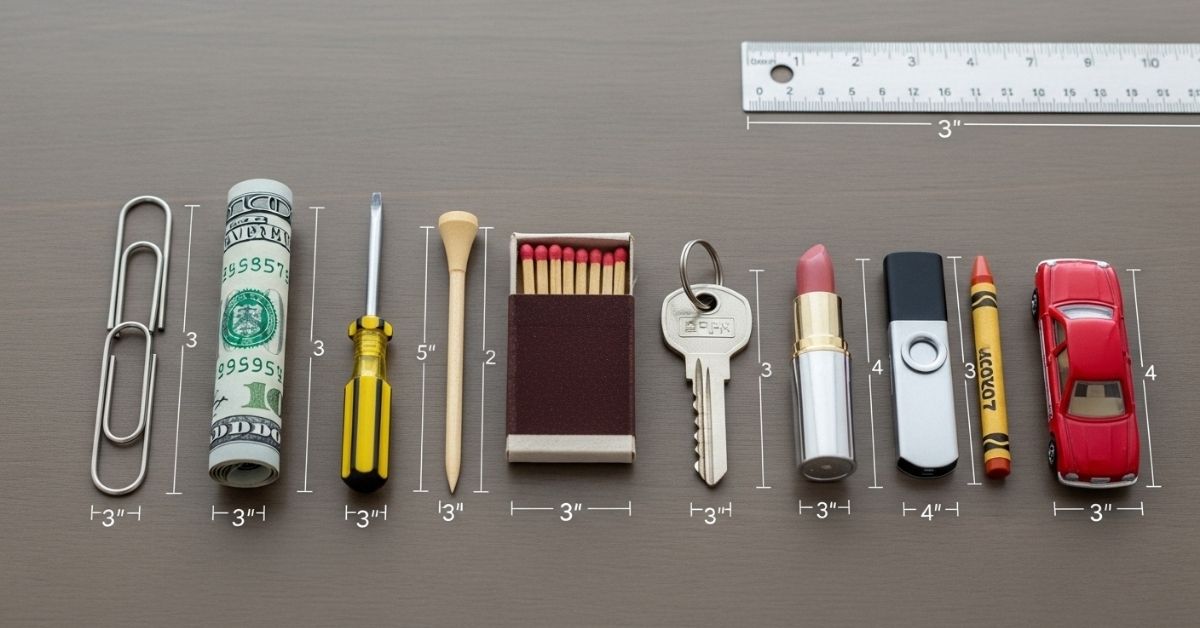
Have you ever needed to measure something quickly but had no ruler nearby? You look around the room, hoping something familiar will give you a clue. It happens more than you’d think. The good news is that 3 inches shows up everywhere in daily life, hiding in plain sight across your desk, bathroom, kitchen, and junk drawer.
This guide walks you through 14 real, everyday objects that measure right around 3 inches. You’ll also pick up some clever tricks for estimating length without any tools at all.
Everyday Measurement Benchmarks: Understanding 3 Inches
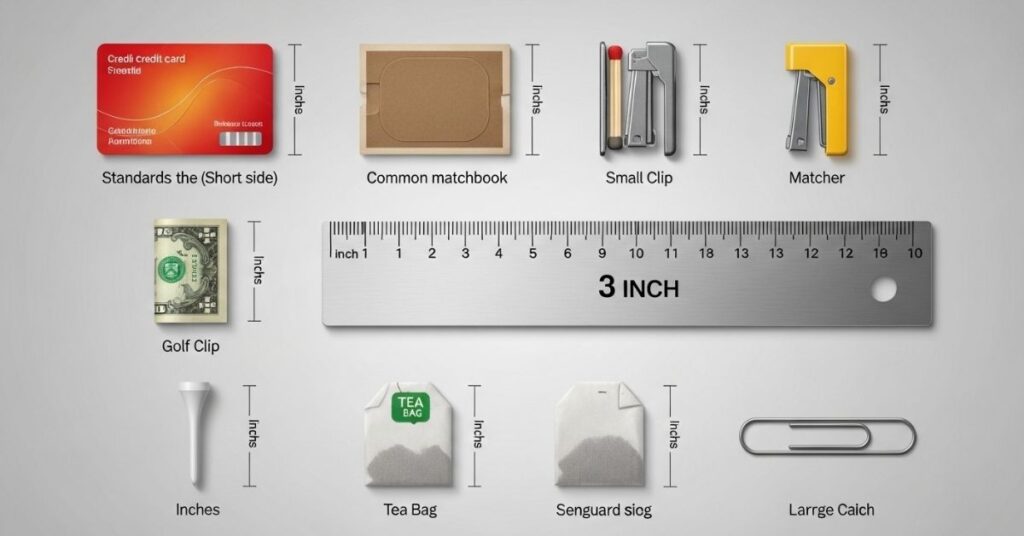
So how big is 3 inches, really? Think of it this way. It’s roughly 7.62 centimeters or 76.2 millimeters. That’s about the width of a standard credit card or the height of a lipstick tube sitting on your vanity.
For most adults, it’s also close to the length of your index finger from the base knuckle to the tip. Not exact for everyone, but close enough to use in a pinch. Once you start seeing 3 inches in familiar objects, estimating length visually becomes second nature.
Here’s a quick reference to ground you:
| Measurement System | Equivalent |
| Inches | 3 inches |
| Centimeters | 7.62 cm |
| Millimeters | 76.2 mm |
Small Office and School Supplies as Visual Length References
Your desk is full of tiny measurement tools. You just never thought of them that way.
Sticky notes are a classic example. The standard 3×3 inch sticky note is exactly 3 inches on each side. Keep one nearby and you’ve got an instant size reference for anything small.
Paper clips are another gem. One standard paper clip measures about 1 inch. Stack three of them end to end and you hit the 3-inch mark perfectly. It sounds silly, but it genuinely works when you need a quick estimate.
Twist ties, the little wire-and-paper strips that come with bread bags, typically measure right around 3 inches. Most people toss them without a second thought. Now you have a reason to keep a few.
A bank card runs about 3.37 inches wide. That’s slightly over the mark, but it’s still one of the most reliable small object size comparisons you can make without a ruler.
Read More: 15 Common Things that are 7 Inches Long
Household Items That Hit the 3-Inch Sweet Spot
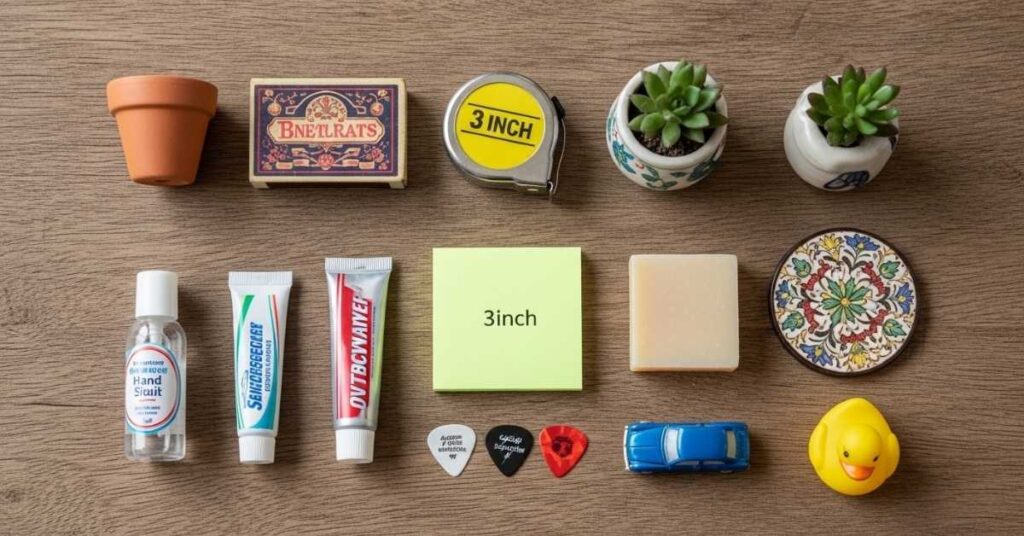
Once you move from your desk to your home, the list keeps growing.
An AA battery is about 1.99 inches long on its own. Stack two and you’re just shy of 4 inches. But stack one and a half, and you’re right at 3. AAA batteries are slightly shorter, so you’d need closer to three stacked together.
Lipstick tubes are one of the most consistent 3-inch examples in daily life. Most standard tubes measure between 3 and 3.5 inches tall. They’re compact, they’re portable, and they’ve been hiding metric conversion secrets the whole time.
Iron nails in the 3-inch size are sold widely in hardware stores. They’re a standard dimension in carpentry, used for framing, furniture, and general repairs. If you’ve got a toolbox, you likely already own a perfect 3-inch benchmark item.
Bottle caps, when stacked three high, also land at roughly 3 inches. Each cap measures about 1 inch in height, so three together give you a surprisingly accurate reference.
Sports Equipment and Compact Everyday Tools
Sports balls are closer to 3 inches than most people realize.
A regulation baseball measures between 2.86 and 2.94 inches in diameter. That puts it just slightly under the 3-inch mark, making it a reliable small-scale measurement reference when you need something round.
Tennis balls run a little smaller at 2.6 to 2.7 inches. They don’t hit 3 inches exactly, but they’re close enough for rough estimates in real life size comparisons.
Neither of these will replace a tape measure. But if you’re trying to explain a small size to someone or visualize a dimension quickly, both work well as practical examples of small sizes.
Technology Meets Tiny Dimensions
Your phone is closer to 3 inches than you’d expect in certain dimensions.
The iPhone 16 has a width of roughly 2.82 inches. That’s near enough to 3 inches that you can use the short edge of your phone as a rough guide. It’s not perfect, but it’s practical when you’re out and about.
Bank cards, as mentioned, are just over 3 inches wide and are arguably the most universally available compact everyday item for quick size estimation. Most people carry one at all times, which makes it a go-to tool for designers, crafters, and curious minds alike.
Visualizing Length with Finger Phalanges
Your hands are the oldest measuring tools in human history.
The index finger, from the lowest knuckle to the fingertip, measures close to 3 inches for most adults. It varies slightly depending on hand size, but it’s a surprisingly accurate benchmark for everyday use.
The thumb tends to run shorter. The average male thumb measures about 2.74 inches, while the average female thumb comes in around 2.49 inches. Still useful for estimating, especially for objects under 4 inches.
This kind of body-based measuring is called anthropometric estimation. It’s practical, always available, and requires zero equipment. Teachers use it to explain small dimension examples to kids, and tradespeople use it constantly on job sites.
Office Hacks: Small Object Length in Practice
Let’s talk about how to actually use these objects day to day.
If you’re wrapping a gift and need to cut ribbon at 3 inches, lay down a sticky note and cut along its edge. Done. If you’re spacing out nails on a piece of wood, use a bank card as a spacer. It gives you a consistent gap that’s close to 3 inches every time.
Designers often use stacked coins or small batteries when sketching product mockups by hand. Three US quarters stacked vertically reach about 3 inches, making them a surprisingly reliable tool in the early stages of prototyping.
Here are a few quick office hacks:
- Use a sticky note as a 3-inch cutting guide for paper crafts
- Stack three paper clips to measure a small opening or gap
- Keep a bank card in your toolkit for consistent spacing
- Use a lipstick tube to estimate height of small decorative objects
Fun with Coins and Stacked Objects
Coins are underrated measuring tools.
Three US quarters stacked on top of each other reach approximately 3 inches in total height. Each quarter is about 0.069 inches thick, so the math works out to roughly 0.207 inches per stack, and stacking 14 to 15 would get you to 3 inches vertically. But laid edge to edge, three quarters span a different distance entirely.
The stacking approach is particularly fun for kids. It turns measurement into a game. You can challenge them to find objects around the house that match the height of three stacked quarters. It’s a simple, hands-on way to explain how to understand small measurements without making it feel like a lesson.
Compact Everyday Items as Design Tools
Designers think in dimensions constantly. And many of them use everyday objects as informal references before they reach for a ruler.
A lipstick tube, a bank card, or three stacked bottle caps all give a physical feel for 3 inches that no number on a screen can replicate. Holding something in your hand and comparing it to another object is one of the most intuitive ways to visualize dimensions easily.
Architects have been known to carry a credit card or a folded sticky note to client walkthroughs for quick reference. It’s a practical habit that bridges the gap between abstract measurements and real-world space.
Household Objects for Engineering Reference
In quick DIY projects, pulling out a full measuring tape for a 3-inch estimate feels like overkill.
A 3-inch iron nail works perfectly as a go-to reference. Keep one near your workbench. When you’re eyeballing a cut or a spacing decision, it tells you exactly what you need to know in seconds.
Twist ties are another underestimated tool. They flex, they’re easy to carry, and at 3 inches they can wrap around small bundles of wire or cord while doubling as a length reference.
Comparing Imperial and Metric Systems with Tiny Objects
Here’s where it gets interesting for anyone who switches between unit systems.
Three inches equals 7.62 centimeters. That’s a clean enough number to remember. If you’re working with metric measurements and want to confirm how big is 3 inches in cm, just think of your standard bank card width or your sticky note side. Both land right at that mark.
For kids learning both systems, using real objects is far more effective than memorizing conversions. Stack three quarters, then write “7.62 cm” next to them. The connection between the number and the physical object sticks in a way that abstract math rarely does.
Practical Design Applications of 3 Inches
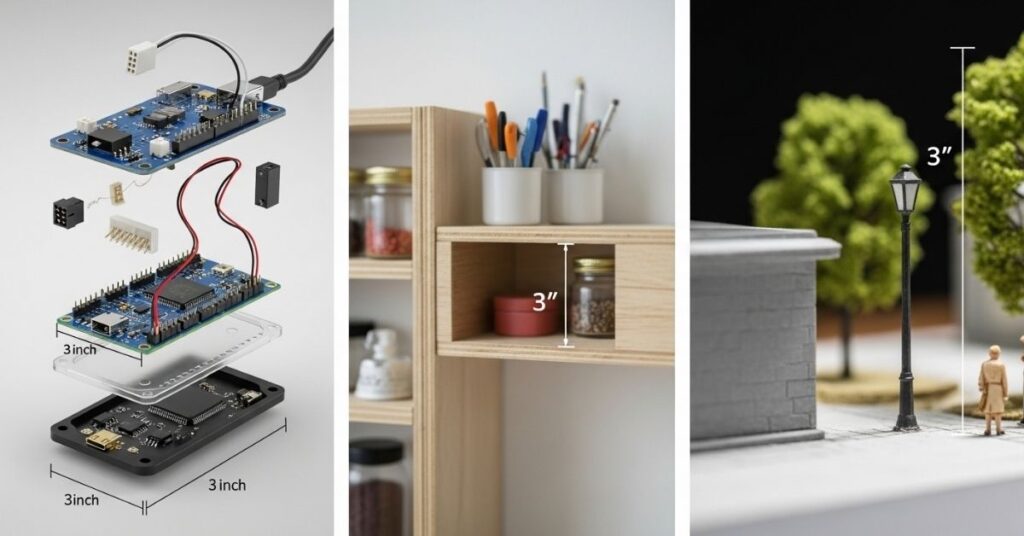
Three inches might seem tiny, but it drives a lot of design decisions.
In electronics, battery compartments, card slots, and USB port spacing all reference this scale. In fashion, accessories like earrings, hair clips, and cufflinks often sit in this size range. In architecture, tile grouting, shelf spacing, and door hardware can all be influenced by small-scale dimensions.
Here’s where 3-inch objects commonly show up in design:
- Electronics housing and battery slot dimensions
- Accessory and jewelry sizing
- Packaging dimensions for compact consumer products
- Shelf spacing in retail and residential design
- Crafting templates and miniature model building
Mini-Stories and Cultural Tidbits
In Japan, gift-giving culture places a premium on precisely sized packaging. Small envelopes and folded paper gifts often measure close to 3 inches in at least one dimension. It’s not random. There’s a cultural mindfulness around compact, considered presentation that values proportion and intentionality.
In Western classrooms, teachers have long used coins, paper clips, and sticky notes as tactile tools for introducing kids to measurement. It grounds abstract numbers in something touchable. That’s the real power of everyday measurement references. They connect math to lived experience.
FAQ’s
What things are exactly 3 inches long?
Sticky notes, iron nails, lipstick tubes, and three stacked US quarters are all reliable examples of objects that measure close to or exactly 3 inches.
How can I measure 3 inches without a ruler?
Use a standard sticky note, a bank card, or your index finger as a visual guide. Each one approximates 3 inches closely enough for everyday estimates.
How big is 3 inches in centimeters?
Three inches equals 7.62 centimeters. A standard bank card width is one of the easiest real-life comparisons for this measurement.
What household items are about 3 inches long?
Lipstick tubes, AA batteries stacked in pairs, bottle caps stacked three high, and 3-inch iron nails all fit within this size range.
How do I explain 3 inches to a child?
Show them three stacked quarters or a sticky note. Hands-on comparisons work far better than numbers alone when teaching kids about small measurements.
Conclusion
Three inches is one of those measurements that sounds small until you start finding it everywhere. Your sticky notes, your lipstick, your spare nails, the coins in your pocket; they’re all telling you the same story in slightly different ways.
Next time you need a quick size reference, skip the drawer full of rulers and look around. Chances are, the answer is already sitting on your desk or in your bag. Once you train your eye to spot 3-inch objects in daily life, estimating length visually becomes one of those quietly useful skills you wonder how you ever lived without.