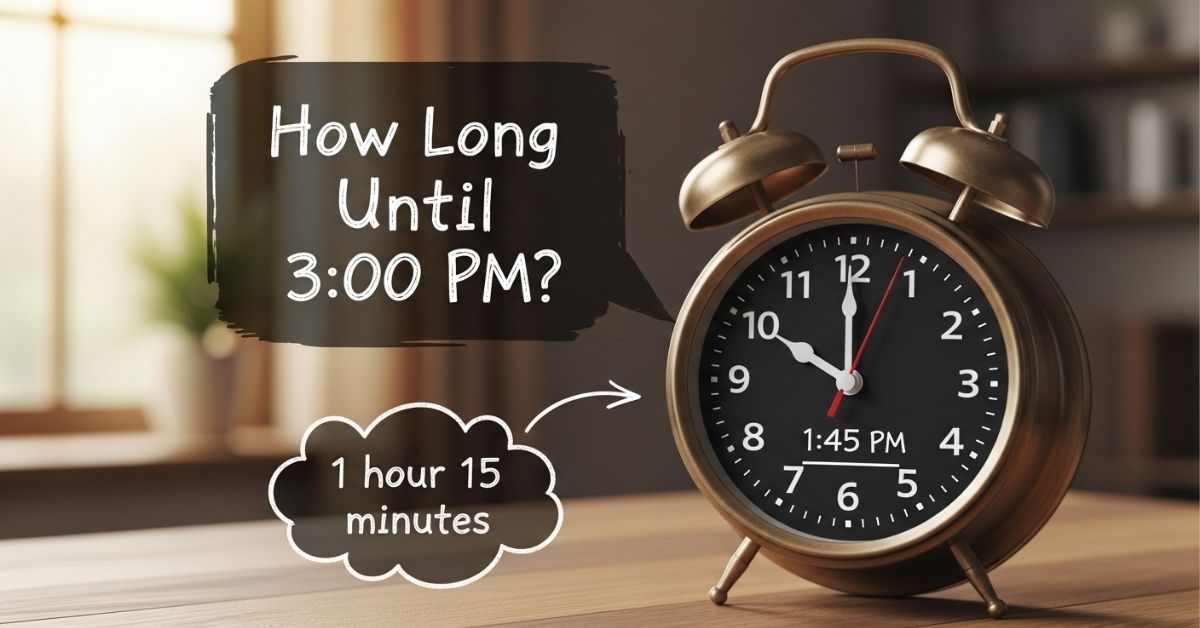
You glance at the clock. It reads 1:17 PM. Your meeting, deadline, or pickup is at 3:00 PM. And suddenly, that gap feels enormous. Sound familiar? Most of us have been there, eyes darting between the screen and the clock, wondering exactly how much time is left.
It sounds like a simple question. But how long until 3:00 PM actually touches on something deeper than just arithmetic. It’s about awareness, planning, and how we relate to time on a daily basis. Whether you’re a student counting down to the end of school, a professional waiting for a call, or a parent timing a school pickup, knowing how to calculate remaining time accurately changes how you use it.
Why Time Matters More Than You Think

Here’s something worth sitting with. Most people don’t actually know what time it is in a meaningful sense. They know the digits on the clock, sure. But they rarely connect that number to how much usable time they have left in the day.
Think about it. If it’s currently 11:00 AM and your target is 3:00 PM, you have four full hours ahead of you. That’s enough time to complete a work report, cook a meal, go for a walk, and still have a buffer. But if you don’t consciously register that gap, those four hours dissolve into scrolling, distraction, and vague anxiety about the ticking clock.
Time awareness isn’t a superpower reserved for productivity gurus. It’s a simple habit. When you know how many hours left until 3 PM, you start filling that window with intention instead of noise. You stop drifting and start doing.
Research consistently shows that people who track time intervals make better decisions about how to spend those intervals. It’s not obsessive. It’s just smart. Knowing the gap between now and a target hour gives your brain a framework. And brains love frameworks.
Read More: 14 Common Things That Are 2 Inches Long
The Art of Calculating Time Until a Specific Hour
Let’s get into the actual mechanics. Calculating how long until 3:00 remains one of those things people guess at rather than actually figure out. Here’s how to do it properly, without pulling out a calculator every time.
Start with your current time. Let’s say it’s 12:45 PM. Your target is 3:00 PM. Subtract the current hour from 3. That’s 3 minus 12, which gives you roughly 3 hours. But you’re not at exactly 12:00, you’re at 12:45. So you subtract those 45 minutes, leaving you with 2 hours and 15 minutes remaining.
Simple formula: target time minus current time equals your countdown window.
Now take it a step further. If you want to know the seconds until 3 PM, just convert. Two hours and 15 minutes equals 135 minutes. Multiply by 60 and you get 8,100 seconds. That level of precision sounds excessive until you’re timing a presentation rehearsal or a sourdough rise. Then it becomes genuinely useful.
What makes this more powerful is pairing the calculation with a task. Don’t just know you have 2 hours and 15 minutes left. Ask yourself what you can realistically finish in that window. That’s when time calculation transitions from mental math into actual time management.
How Long Until 3:05 PM, 3:10 PM, and Beyond
Not every countdown lands exactly on the hour. Life rarely does. So let’s handle those common variations the same way.
If your target is 3:05 PM and it’s currently 1:30 PM, the gap is 1 hour and 35 minutes. That’s 95 minutes, or 5,700 seconds. The method is identical. You subtract your current time from your target time, then convert as needed.
For 3:10 PM from a 2:00 PM starting point, you’ve got 1 hour and 10 minutes, which is 70 minutes. And from 2:45 PM to 3:10 PM? That’s just 25 minutes. Enough time for a focused task, a short walk, or a decent cup of tea.
The point here is that every time interval, whether it’s 8 minutes or 80 minutes, holds value. The mistake people make is dismissing short windows. “I only have 20 minutes, so why bother starting anything?” That thinking costs you enormous amounts of accumulated time over days and weeks. Twenty minutes of focused work, done repeatedly, builds something real.
Tools That Make Counting Down a Breeze
You don’t always want to do the mental math. That’s completely reasonable. Fortunately, there are excellent tools designed specifically to handle a real-time countdown display or a countdown timer for specific time targets.
Online countdown timers are the most accessible option. Sites like timeanddate.com or online-stopwatch.com let you input any target time and generate a live timer with seconds precision. You can even enable a fullscreen timer online, which is genuinely helpful when you’re presenting or working at a desk and want the time visible at all times.
For smartphone users, the built-in clock app on both Android and iOS offers a timer mode that handles countdown setups with ease. Third-party apps like Focusmate, Forest, or even Google’s built-in timer handle this well. You set the time, you see the countdown, and your brain gets a clear visual anchor.
If you want something more integrated with your workflow, tools like Toggl or Clockify don’t just count down but also track how you spend each interval. These double as time tracking tools that show you patterns over days and weeks, which is where real insight lives.
For desktop environments, browser extensions like “Tab Countdown” let you set a timer for 3 PM directly in your browser tab. Useful for professionals who live inside Chrome or Firefox all day.
The right tool isn’t necessarily the most sophisticated one. It’s the one you’ll actually use consistently.
Real-Life Stories About Waiting for the Clock

Ask anyone who has worked a shift job, and they’ll tell you something revealing. The last hour before 3 PM moves slower than any other hour in the day. There’s a phenomenon behind this, and it’s not just impatience.
Psychologists refer to it as “clock-watching paradox,” where anticipating a moment actually slows your perception of time passing. The more you check, the slower it seems to go. This is why time feels slower when waiting compared to when you’re absorbed in a task.
A teacher once described waiting for the 3:00 school bell as “watching paint dry in slow motion.” Her solution was to restructure the final hour of her day with a specific task that required full attention. Grading, lesson planning, something tactile. She stopped noticing the clock because her hands and mind were occupied elsewhere.
A logistics manager shared a similar trick. He used a schedule countdown timer on his monitor to break the afternoon into three 20-minute segments. Each segment had a defined task. By the time 3:00 PM arrived, he’d accomplished more in that final hour than in the two that preceded it.
These aren’t extraordinary people with extraordinary willpower. They simply changed their relationship with the clock by making the countdown work for them rather than against them.
Making Your Countdown Personal
Here’s where it gets genuinely interesting. The question of how long until 3:00 PM doesn’t have to feel like a chore. You can build rituals around it.
Some people use the countdown as a trigger for habit stacking. Thirty minutes before 3 PM becomes the signal to wrap up open tabs, write a quick summary of what was accomplished, and transition mentally to the next part of the day. That transition ritual, small as it sounds, adds structure to an otherwise fluid afternoon.
Others use the countdown as a reflection checkpoint. What was I supposed to accomplish today? How much is done? What still needs attention? Using the hours left until 3 PM as a personal audit creates a rhythm that builds self-awareness over time.
You can also use the countdown for something completely personal. Maybe 3 PM is when you step away from work and take 10 minutes for yourself. A walk, a stretch, a few minutes outside. Anchoring that habit to a specific time gives it staying power. It becomes automatic, which is exactly what you want from a healthy routine.
How Long Until… Is Also About Reflection
There’s a quiet philosophical angle here worth acknowledging. When you ask how long until 3:00 PM, you’re implicitly asking what that time represents to you. An appointment. A deadline. A relief point. A moment of transition.
Time intervals carry emotional weight. The wait before a doctor’s appointment feels different from the wait before a vacation flight, even if both are exactly 90 minutes. The content of those minutes, the meaning we assign to the endpoint, shapes how we experience the wait.
Understanding this helps you manage waiting time productively rather than just enduring it. If you know 3 PM represents something stressful, you can intentionally fill the preceding window with calming, low-stakes activity. If 3 PM signals something exciting, you might channel that energy into a focused burst of work beforehand.
Being mindful about time isn’t about being rigid or mechanical. It’s about recognizing that you have more agency over how those minutes feel than you might realize.
Practical Advice for Time Enthusiasts
If you find yourself frequently checking how many hours left until 3 PM or calculating time gaps throughout the day, here are some grounded practices worth adopting.
Start each day by identifying your time anchors, the specific hours that define your schedule. If 3 PM is a recurring checkpoint, note what happens before it and what should happen after it. This framing transforms random clock-watching into structured time awareness.
Use a visible timer during deep work. Whether it’s a digital countdown timer on your monitor or a simple kitchen timer on your desk, seeing the time remaining sharpens focus in a way that background awareness doesn’t. It creates a mild sense of urgency without panic.
Break longer intervals into smaller chunks. If you have two hours until 3 PM, divide that into four 30-minute segments. Assign each a purpose. This approach, sometimes called time blocking, dramatically reduces the feeling that time is slipping away without progress.
Review your time estimates. After each interval, ask yourself: did I underestimate or overestimate how long that task would take? Over time, this reflection improves your accuracy and reduces scheduling stress.
Finally, avoid multi-tasking during counted-down intervals. The research here is overwhelming. Switching between tasks increases cognitive load and reduces the quality of output. One focused task per interval will always outperform three scattered ones.
Frequently Asked Questions
how long until 3pm
The answer depends entirely on your current time. Subtract your current hour and minutes from 3:00 PM to get the exact gap. For instance, if it’s 1:00 PM right now, you have exactly 2 hours remaining.
how many more hours until 3pm today
Check your current time and count forward. If it’s 10:30 AM, you have 2 hours and 30 minutes until 3:00 PM. If it’s 2:45 PM, you only have 15 minutes left.
how long till 3pm
Same calculation applies. Take 3:00 PM as your target and subtract whatever time it currently is. The difference is your countdown window, whether that’s hours, minutes, or seconds.
how many minutes till 3pm today
Convert your remaining hours into minutes. One hour equals 60 minutes. So if you have 1 hour and 20 minutes left, that’s 80 minutes total. Multiply remaining hours by 60, then add leftover minutes.
how long until 3:00
If you’re asking about 3:00 AM, the answer stretches past midnight. But for 3:00 PM, just check the current time and subtract from 15:00 using a 24-hour format for clarity. Online countdown tools handle this instantly.
Conclusion
So, how long until 3:00 PM? The honest answer is it depends on when you’re reading this. But more importantly, the real answer involves more than just arithmetic. It’s about what you do with the time between now and then.
Whether you use a simple mental calculation, a digital countdown timer, or a time tracking app, the goal is the same. Make that window count. Don’t just wait for 3 PM. Work toward it, reflect during it, and arrive at it with something to show.
Time is the one resource that doesn’t refill. Use the countdown wisely.