
Have you ever tried to picture 40 feet in your head and drawn a complete blank? You are not alone. Most people can picture an inch or a yard with ease, but 40 feet sits in that awkward in-between zone, longer than any room in your house, yet not quite what most people would call enormous. The good news is that you encounter 40-foot objects almost every single day without realizing it.
Whether you are planning a landscaping project, renting a moving container, or simply satisfying everyday curiosity, understanding what 40 feet looks like in real life is surprisingly useful. In this guide, we break it all down using 10 familiar, relatable reference points anyone can picture instantly.
How Long Is 40 Feet?
At its core, 40 feet is a linear measurement representing the distance from one point to another across 40 feet of space. To picture it quickly: imagine eight average adults lying head to toe in a straight line. That chain of people would stretch almost exactly 40 feet.
Another easy mental image? Think of two compact cars parked perfectly bumper to bumper. Their combined length gets you very close to the 40-foot mark. At a normal walking pace of about 3 feet per second, it takes roughly 13 to 15 seconds to walk 40 feet from one end to the other.
Read More: How Long Is 300 Feet? 9 Things That Are 300 Feet Long Or Big – 2026
How Long Is 40 Feet in Other Units of Measurement?
Before diving into real-world comparisons, it helps to see 40 feet expressed in other units. This makes it easier to work across different industries, countries, and contexts.
| Unit of Measurement | Equivalent to 40 Feet |
| Inches | 480 inches |
| Yards | 13.33 yards |
| Meters | 12.19 meters |
| Centimeters | 1,219 centimeters |
| Millimeters | 12,190 millimeters |
These conversions are especially useful for construction professionals, architects, engineers, and anyone working on international projects where metric units are the standard. Knowing that 40 feet equals 12.19 meters, for example, makes cross-border planning significantly smoother.
How High Is 40 Feet in the Air?
Vertical height is where 40 feet gets truly impressive. Standing beneath something 40 feet tall, whether it is a tree, a building, or a utility pole, gives you a genuine sense of how substantial this measurement really is.
A four-story building stands at approximately 40 feet tall when each floor has standard 10-foot ceilings. That is tall enough to require an elevator in most modern buildings and tall enough that falling from the top would be extremely dangerous. To put the height in even simpler terms:
- It is roughly the height of four stacked school buses standing on their roofs.
- It is taller than most mature backyard trees.
- It is high enough that a person on the ground would appear noticeably small to someone standing at the top.
Firefighters, window washers, and construction crews regularly work at 40-foot heights using specialized equipment like aerial lifts and extension ladders designed specifically for this range.
Read More: How Big Is 2mm? 9 Most Common Things That Are 2mm In Size
What Does 40 Feet Look Like in Real Life?
The best way to truly grasp 40 feet is through objects you already know. The sections below walk through 10 of the most relatable real-world examples, from things you see on your morning commute to creatures swimming in the deep ocean.
1. A Standard Shipping Container

One of the most precise real-world references for 40 feet is the standard ISO intermodal shipping container. These steel boxes are manufactured to exact international specifications, and the most common size is exactly 40 feet long.
A standard 40-foot shipping container holds approximately 2,700 cubic feet of cargo. That is enough interior space to fit the entire contents of a three to four-bedroom home or roughly 20 standard freight pallets. These containers are used in global trade every single day, stacked aboard massive cargo ships and hauled across highways on flatbed trailers. Their uniform dimensions are what make worldwide logistics efficient and predictable.
The next time you spot one of these massive steel boxes at a port, on a train, or being towed down the highway, you are looking at one of the most accurate 40-foot references on the planet.
2. Six Christmas Trees

Here is one of the more creative ways to visualize 40 feet. A typical Christmas tree used in most American homes stands between 6 and 7 feet tall. If you lined up six of those trees end to end on the ground, you would have a row stretching between 36 and 42 feet, putting you squarely in the 40-foot range.
This comparison works particularly well for vertical thinking. Stacking six Christmas trees on top of one another would give you a tower approximately as tall as a four-story building. It turns an abstract number into a festive mental image that is surprisingly easy to recall and use as a quick reference throughout daily life.
Read More: How Long is 20 Feet?
3. A Standard School Bus

Perhaps the single most universally recognized reference for 40 feet is the standard American school bus. Type C school buses, the most common type found across the country, measure between 35 and 40 feet in length. These are the iconic yellow vehicles you see lined up outside elementary schools every morning and afternoon.
A full-size 40-foot school bus can seat between 72 and 90 students, arranged in rows along both sides of the aisle. Their length is carefully standardized to balance two critical needs: carrying enough passengers to make each route efficient and remaining short enough to navigate residential streets, narrow intersections, and school driveways safely.
The next time a school bus passes you on the road or sits parked at the curb, take a moment to observe its full length from front bumper to rear door. That is your 40-foot visual anchor, available on nearly every American street during the school year.
4. A Light Pole

Take a walk down any urban or suburban street and look up. Those light poles lining the road are a reliable everyday reference for 40 feet of vertical height. Standard street lighting poles used in residential and commercial areas typically stand between 35 and 40 feet tall, carefully engineered to illuminate roads and sidewalks without leaving dark spots between fixtures.
These poles serve far more than just a lighting function. They carry power lines, support traffic signals, host surveillance cameras, and often hold festive decorations during holidays. Their height is not arbitrary, it is calculated to ensure the spread of light covers the maximum road surface area with the minimum number of fixtures.
Light poles are made from materials like steel, aluminum, concrete, or fiberglass, and they are designed to withstand high winds and harsh weather conditions for decades. The next time you stand directly beneath one, look straight up and appreciate that you are looking at 40 feet of engineered infrastructure.
5. A Whale Shark

Of all the living creatures on Earth, the whale shark offers one of the most dramatic illustrations of what 40 feet looks like. The whale shark is the largest known fish species in the world, and most adult specimens reach lengths of 32 to 40 feet. Some especially large individuals have been recorded at over 40 feet, with the largest verified whale shark measuring an astonishing 61.7 feet.
Despite their immense size, whale sharks are completely harmless to humans. They are gentle filter feeders, swimming slowly through warm tropical waters with their massive mouths open to collect plankton, krill, and small fish. Their mouth alone can reach five feet wide, nearly as tall as an average adult human.
Imagining a creature the full length of a school bus gliding silently through the ocean puts 40 feet into a context that numbers alone simply cannot match.
6. A 4-Story Building

Vertical measurement is often harder to picture than horizontal distance, and a four-story building is one of the clearest ways to visualize 40 feet of height. Using the International Building Code standard of approximately 10 feet per floor, a four-story structure reaches exactly 40 feet from the ground to the roofline.
This height is common in urban apartment complexes, office buildings, hotels, and parking structures found in cities and towns across the country. It is tall enough to feel genuinely imposing when you stand at the base and look up, yet not so tall that it disappears into the skyline.
Height Comparison at a Glance
| Number of Floors | Approximate Height |
| 1 story | 10 feet |
| 2 stories | 20 feet |
| 3 stories | 30 feet |
| 4 stories | 40 feet |
| 5 stories | 50 feet |
The four-story benchmark is also significant in construction because buildings above four stories in most jurisdictions trigger additional fire safety, elevator, and structural requirements under local building codes.
7. Half the Length of a Tennis Court

A regulation tennis court measures 78 feet in total length. That means 40 feet covers just slightly more than half of a full court, from one baseline to a point just past the service line on the opposite side. For anyone familiar with the sport, this is an immediate and vivid frame of reference.
Tennis courts are also useful because their markings are precisely painted, allowing you to walk off half the court and experience 40 feet physically, not just conceptually. Whether you are designing a backyard recreation area, planning a parking lot, or estimating dimensions for a landscaping project, picturing half a tennis court is a fast and reliable mental shortcut.
8. Extension Ladder
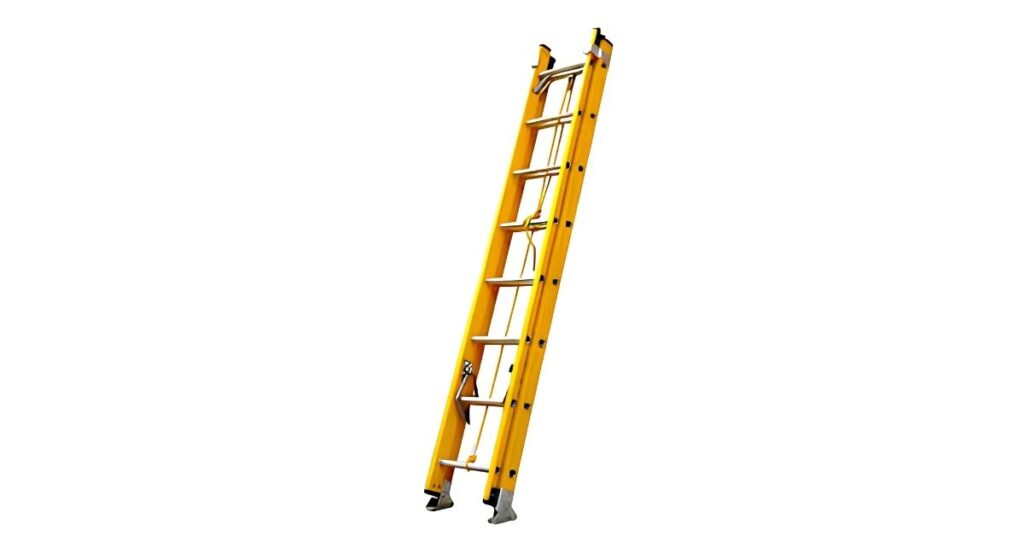
Extension ladders are among the few everyday tools designed specifically to reach heights around 40 feet. A 40-foot extension ladder is a standard piece of equipment for professional painters, window washers, gutter installers, roofers, and electricians working on four-story structures.
These ladders are built with safety as the top priority. They feature stabilizing feet, locking rung mechanisms, and non-slip rungs to prevent accidents at significant heights. When fully extended to 40 feet, a ladder of this size gives you a very tangible feel for the measurement, you can see exactly how high 40 feet stretches when you look up from the ground.
For homeowners, a 40-foot extension ladder is the go-to choice for tasks like cleaning gutters on a tall home, hanging exterior lights on a high roofline, or trimming the upper branches of a mature tree.
9. Half the Length of a Basketball Court
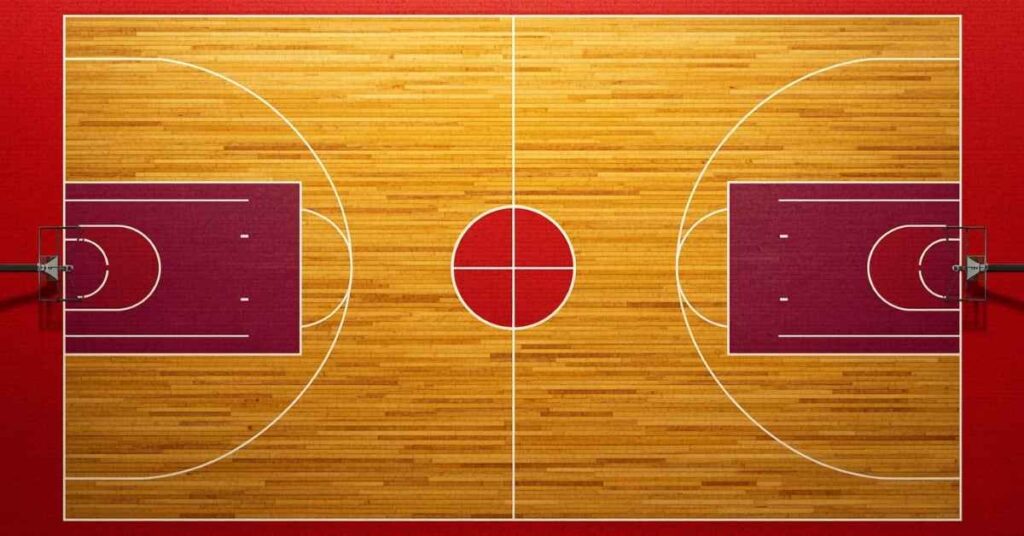
A regulation NBA or NCAA basketball court measures 94 feet in length and 50 feet in width. Half the length of a professional court works out to 47 feet, which means 40 feet falls just short of the half-court line on a professional floor.
However, 40 feet is close enough to half-court that it is a genuinely useful reference. It covers the distance from one baseline past the free-throw line and deep into the paint on the far side. Many recreational and community courts are built shorter than regulation size, and some half-courts are designed at exactly 40 feet to fit space-constrained facilities like gymnasiums, driveways, and community centers.
For anyone who has played pickup basketball or watched a game courtside, the 40-foot distance is a familiar stretch of hardwood that translates perfectly to everyday spatial reasoning.
10. A Red Maple and English Oak

Mature trees provide one of nature’s most organic illustrations of 40 feet. The Red Maple (Acer rubrum), one of the most widely distributed tree species in North America, commonly reaches heights of 40 to 60 feet under normal growing conditions. In autumn, these trees produce the brilliant red and orange foliage that defines the fall landscape across the eastern United States and Canada.
The English Oak (Quercus robur) is similarly impressive, often reaching 40 feet in height and spreading equally wide at full maturity. These long-lived trees can survive for centuries and are iconic landmarks in European parks, forests, and countryside estates.
Both species serve as excellent natural benchmarks for 40 feet. The next time you admire a full-grown maple or oak, you are looking at a living ruler that measures out this distance in real time, one growing season at a time.
Conclusion
Forty feet is one of those measurements that shows up constantly in everyday life once you know what to look for. From the school bus rolling through your neighborhood and the shipping container on the highway to the light pole at the corner and the whale shark cruising through tropical waters, this measurement defines a surprising number of the structures, vehicles, and living things around us.
The key takeaways are simple:
- 40 feet equals 480 inches, 13.33 yards, or 12.19 meters.
- It is the height of a standard four-story building.
- It is the length of a regulation school bus and a standard shipping container.
- It is roughly the maximum length of the world’s largest fish, the whale shark.
- It falls just short of half the length of an NBA basketball court.
The next time you need to estimate, plan, or simply picture 40 feet, pick any one of these references and let it do the work for you.
FAQ’s
How long is 40 feet compared to a car?
A standard mid-size sedan like a Toyota Camry is about 15 feet long, so three cars parked bumper to bumper would measure approximately 45 feet, just slightly longer than 40 feet.
How many steps is 40 feet?
At an average stride length of about 2.5 feet, it takes roughly 16 steps to walk 40 feet.
Is 40 feet the same as 40 meters?
No. Forty feet equals approximately 12.19 meters, which is significantly shorter than 40 meters (about 131 feet).
How long does it take to walk 40 feet?
At a normal walking pace of around 3 feet per second, walking 40 feet takes approximately 13 to 15 seconds.
What is the easiest way to visualize 40 feet?
The easiest everyday reference is a standard school bus. Most Type C buses measure very close to 40 feet from front bumper to rear door and can be spotted in virtually any neighborhood.
Is 40 feet tall for a building?
Forty feet is considered mid-range for building heights. It equals a four-story structure, which is tall enough to require additional safety and accessibility considerations under most building codes but is not considered a high-rise.
How many people lying head to toe equal 40 feet?
Assuming an average adult height of approximately 5.5 to 5.8 feet, it takes roughly seven to eight people lying end to end to equal 40 feet.