Have you ever tried to picture 300 feet in your head and come up blank? You are not alone. Abstract numbers are hard to visualize, but once you connect them to real-world objects, the distance clicks instantly. Whether you are measuring a property line, planning a construction project, or just curious about scale, knowing what 300 feet looks like in everyday life is genuinely useful.
This guide breaks down 300 feet using nine relatable, real-world comparisons ranging from natural wonders to engineering marvels, so you can picture this distance clearly every time.
How Long Is 300 Feet?
300 feet is a significant measurement that equals 100 yards, 91.44 meters, 3,600 inches, and approximately 0.057 miles. It is roughly the height of a 28 to 30-story building and just about the length of an NFL football field from goal line to goal line (excluding end zones).
Here is a quick reference table to understand 300 feet across different units of measurement:
| Unit | Equivalent to 300 Feet |
| Yards | 100 yards |
| Meters | 91.44 meters |
| Inches | 3,600 inches |
| Centimeters | 9,144 centimeters |
| Kilometers | 0.091 kilometers |
| Miles | 0.0568 miles |
| Stories (building) | Approx. 28 to 30 stories |
This measurement appears in sports, architecture, nature, and engineering far more often than most people realize.
Read More: How Big Is 2mm? 9 Most Common Things That Are 2mm In Size
What Does 300 Feet Look Like? Objects Big and Long
Visualizing 300 feet becomes easy once you compare it to familiar structures. The nine examples below cover everything from sports fields to ancient trees, each giving you a solid mental anchor for this distance.
1. A Football Field

The most iconic reference for 300 feet in American culture is the NFL football field. From one goal line to the opposite goal line, a regulation NFL field measures exactly 300 feet (100 yards). This does not include the two 10-yard end zones at each end, which bring the total field length to 360 feet.
If you have ever watched a game on TV or attended one in person, you already have a built-in mental ruler. Standing at one goal line and looking to the other gives you a perfect, real-life picture of 300 feet stretched out before you. The sheer distance quarterbacks throw the ball across this space makes the measurement feel truly impressive.
Quick fact: A standard soccer field maximum width under FIFA regulations is also 300 feet (100 yards), giving you another familiar horizontal reference.
2. The Height of a 30-Story Building
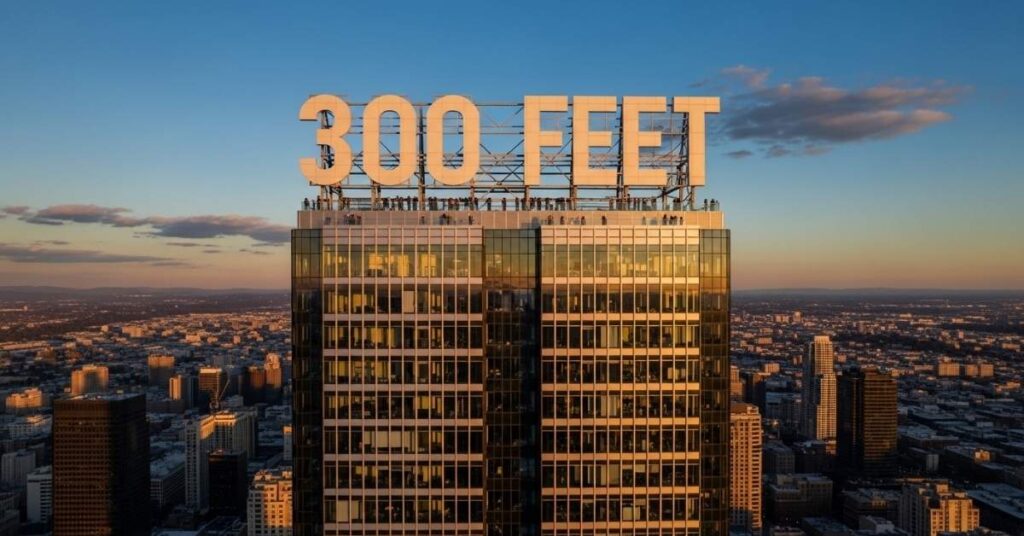
Look up at a downtown skyscraper and count roughly 30 floors. That height from street level to the roofline is approximately 300 feet. Standard commercial buildings in the United States are designed with a floor-to-floor height of about 10 feet, which means 30 floors stacks up neatly to this measurement.
This makes 300 feet a mid-rise benchmark in architecture. Buildings of this height define the skylines of dozens of mid-size American cities. They are tall enough to dominate the horizon from a distance but short enough that you can still count individual floors from the sidewalk.
Note: The famous Statue of Liberty, including its pedestal, stands at approximately 305 feet, making it a close real-world match to this scale.
Read More: How Long is 20 Feet?
3. Giant Sequoia Trees

Nature produces its own 300-foot wonders. Giant sequoia trees (Sequoiadendron giganteum), found exclusively on the western slopes of California’s Sierra Nevada mountain range, commonly reach heights of 250 to 316 feet, placing many of them right at the 300-foot mark.
These trees are the largest living organisms on Earth by volume. Their trunks can measure up to 30 feet in diameter at the base, and they can live for more than 3,000 years. The General Sherman Tree in Sequoia National Park stands at 275 feet tall and is considered the world’s largest living tree by volume.
Standing beneath one of these giants and tilting your head back to see the canopy gives you one of the most powerful ways to feel 300 feet. The Natural History Museum notes that these trees reach more than 300 feet tall with diameters of up to 26 feet, making them one of nature’s most staggering displays of scale.
4. Large Ferris Wheels

Modern observation Ferris wheels have grown into architectural landmarks of their own. Many of the world’s prominent large Ferris wheels reach heights in the range of 200 to 300 feet, with some classic fairground giants sitting right at the 300-foot threshold.
At this height, a Ferris wheel car at the very top sits a full 300 feet above the ground, offering panoramic views across entire city districts. The diameter of the wheel itself often spans close to 280 to 300 feet, making the structure as wide as it is tall.
These structures demonstrate how 300 feet translates into a ride experience: high enough for spectacular views, massive enough to dominate a fairground skyline, and visually striking from miles away.
Read More: How Big is 9 Inches: 12 Common Things That Are 9 Inches Long: Everyday Objects You See Often
5. Suspension Bridge Span Sections

Major suspension bridges are built in carefully engineered segments. Individual span sections between support towers on many mid-size suspension bridges measure between 250 and 300 feet. These sections must bear enormous loads, including vehicle traffic, wind forces, and the weight of the deck itself.
A single 300-foot bridge span section gives structural engineers a manageable and proven length for load distribution. Driving or walking across one of these sections from tower to tower covers the full 300-foot distance in a matter of seconds, yet the engineering behind that short stretch can represent years of calculation and design work.
Bridges like these appear across river crossings and coastal channels throughout the United States, making suspension span sections one of the most quietly common places where 300 feet shows up in everyday infrastructure.
6. Blue Whales in a Line (3 Whales = 300 Feet)

The blue whale is the largest animal ever known to have existed on Earth. An adult blue whale averages approximately 100 feet in length, which means lining up just three of these ocean giants end to end produces a total length of exactly 300 feet.
To put that into perspective, three animals, each the weight of multiple commercial aircraft, stretched bumper to bumper would fill a full football field. It is one of the most mind-bending ways to conceptualize this distance because it connects an abstract number to a living creature whose scale is already almost impossible to believe.
The blue whale comparison is a favorite among marine educators because it bridges the gap between ocean biology and spatial reasoning in a way that sticks in the memory.
7. Mega-Yachts

Ultra-luxury mega-yachts represent one of the most extravagant real-world expressions of 300 feet. These floating palaces typically measure between 280 and 300 feet in length and include multiple decks, helipads, swimming pools, cinema rooms, and private suites spread across their enormous hulls.
At 300 feet, a mega-yacht is comparable in length to a football field. Owning or chartering a vessel this large requires a crew of dozens of professionals. These yachts are essentially self-contained luxury resorts that happen to move through the water.
Seeing a mega-yacht docked at a marina makes the 300-foot measurement viscerally real. Its bow stretches so far from the stern that walking the full length of the deck feels like a genuine stroll.
8. Wind Turbine Towers

Modern onshore wind turbines are engineering achievements that put 300 feet into a clean energy context. Tower heights for large wind turbines typically range from 260 to 300 feet before the blades are even factored in. The turbine blades themselves add another 150 to 200 feet on top of that.
The towers are built tall to capture stronger, more consistent wind speeds found at greater altitudes. A single tower can weigh more than 200 tons and requires a massive concrete foundation to anchor it against decades of wind loading.
Driving past a wind farm on an open highway and looking up at these towers gives an immediate sense of how imposing 300 feet truly is when it is right in front of you. They dwarf nearby trees, power lines, and even highway overpasses.
9. Volcano Lava Tubes
Lava tubes are natural geological tunnels formed when the outer layer of a lava flow cools and hardens while molten rock continues moving through the interior. Once the lava drains out, it leaves behind a hollow cave. Many of the world’s most impressive lava tubes reach lengths of several hundred feet per chamber segment, with some individual passages stretching 300 feet or more in a single run.
Hawaii’s lava tubes are among the most famous examples. Walking through a 300-foot lava tube section means traveling the equivalent of a football field entirely underground, surrounded by basalt walls that record the exact path of an ancient volcanic eruption. These geological formations remind us that 300 feet appears not just above ground but deep within the Earth itself.
How Long Is 300 Feet to Walk?
At an average walking speed of 3 miles per hour (approximately 4.4 feet per second), covering 300 feet takes about 68 seconds, just over one minute. Most adults complete the distance in 100 to 120 steps depending on stride length.
Here is a simple speed and time breakdown:
| Walking Speed | Time to Cover 300 Feet |
| Slow (2 mph) | Approx. 102 seconds |
| Average (3 mph) | Approx. 68 seconds |
| Brisk (4 mph) | Approx. 51 seconds |
In practical terms, 300 feet is about the distance from one end of a large supermarket to the other, or the length of a typical city block in many downtown areas.
Understanding the Foot
The foot as a unit of measurement has a history stretching back thousands of years. Ancient Romans standardized the foot for use in public construction and military surveying. Over centuries, different cultures adapted the measurement until the international standard was set at exactly 12 inches or 0.3048 meters.
Today, the foot remains the primary unit of distance measurement in the United States and a handful of other countries. It is especially embedded in industries like construction, aviation, real estate, and sports, where imperial measurements remain the standard despite the global shift toward metric units.
Metric vs. Imperial Systems
Understanding how 300 feet converts into the metric system helps put the distance into global context.
| Imperial | Metric Equivalent |
| 300 feet | 91.44 meters |
| 300 feet | 0.091 kilometers |
| 300 feet | 9,144 centimeters |
The imperial system, used primarily in the United States, relies on units like inches, feet, yards, and miles. The metric system, used by most of the world, is built on a decimal framework with meters, kilometers, and centimeters.
For everyday estimation, the easiest conversion to remember is that 1 foot equals approximately 0.3 meters, making 300 feet roughly 90 meters, close enough for most practical mental calculations.
FAQ’s
How many meters is 300 feet?
300 feet equals exactly 91.44 meters, since one foot is 0.3048 meters.
Is 300 feet the same as a football field?
Yes, an NFL football field from goal line to goal line (excluding end zones) measures exactly 300 feet (100 yards).
How many stories is 300 feet tall?
At a standard floor height of 10 feet, 300 feet equals approximately 28 to 30 stories.
How many cars fit in 300 feet?
Using an average car length of 15 feet, approximately 20 cars lined up bumper to bumper would span 300 feet.
How long does it take to walk 300 feet?
At an average walking pace of 3 miles per hour, walking 300 feet takes approximately 68 seconds, just over one minute.
How many blue whales make 300 feet?
Since an average adult blue whale is about 100 feet long, exactly three blue whales lined up end to end equal 300 feet.
Is 300 feet close to a mile?
No, 300 feet is quite short relative to a mile. One mile equals 5,280 feet, so 300 feet is only about 5.7 percent of a mile.
Conclusion
Three hundred feet is one of those measurements that sounds abstract until you connect it to something you can see, touch, or walk past. Whether you picture a full NFL football field, a 30-story building rising above a downtown skyline, three blue whales in a line, or the soaring trunk of a giant sequoia, the distance suddenly becomes real.
From natural wonders to feats of engineering, 300 feet shows up across sports, architecture, marine biology, and renewable energy in ways most people never think about. The next time someone asks you how long 300 feet is, you will have nine vivid comparisons ready to bring the number to life.