
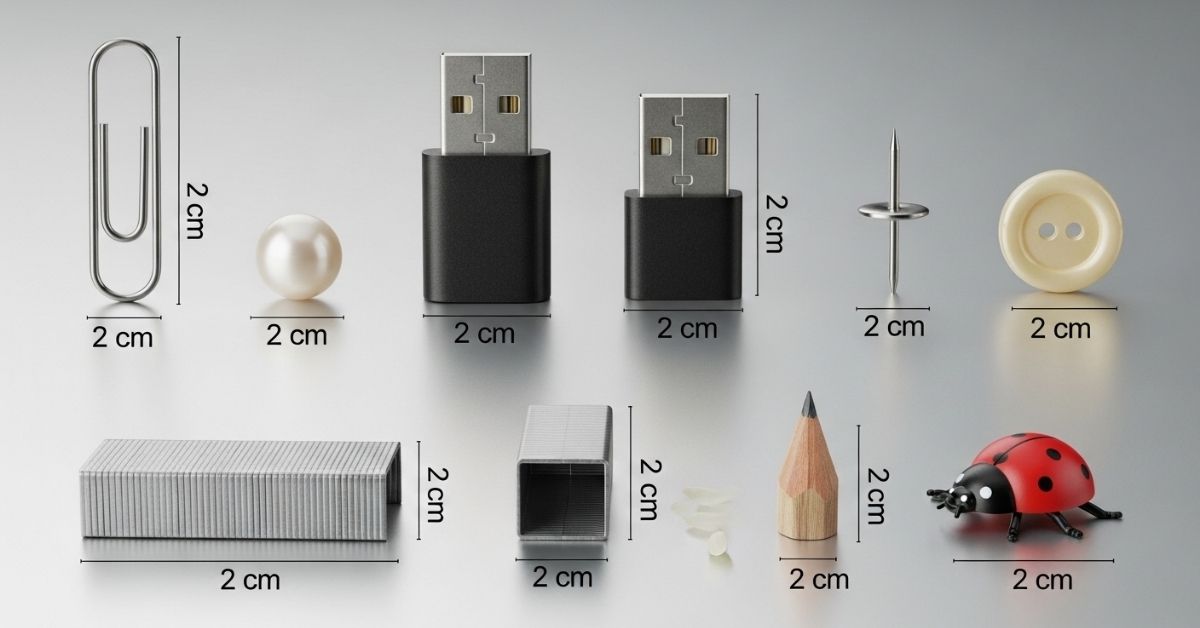
14 Everyday Things That Are 2 Centimeters Long
Two centimeters. It sounds almost too small to matter. But once you start noticing it, you realize this tiny measurement shows up everywhere in your daily life. On your desk, in your kitchen drawer, tucked inside your pencil case. It’s hiding in plain sight.
Most people struggle to picture small metric measurements without a ruler in hand. You might know that 2 cm equals roughly 0.79 inches, but that still doesn’t paint a clear picture in your mind. That’s exactly why this guide exists. We’re going to walk through 14 real, tangible things that are 2 centimeters long so you can finally lock this measurement into your memory for good.
2 Centimeters – Quick Size Reference Table
Before we dive into the details, here’s a fast visual reference to get your bearings. This table gives you a snapshot of objects that sit right around that 2 cm mark.
| Object | Approximate Size | Notes |
| Standard staple | 2 cm wide | Common office item |
| Pencil eraser tip | ~2 cm | Varies by brand |
| Shirt button | ~2 cm diameter | Mid-sized button |
| AAA battery tip | ~2 cm diameter | Top of battery |
| Sugar cube | ~2 cm each side | Standard size |
| Thumbnail width | ~2 cm | Average adult |
| Blueberry | ~1.5 to 2 cm | Fresh, medium-sized |
| SIM card chip | ~2 cm length | Nano to micro |
| Lego stud row | ~2 cm | Two standard studs |
| Pencil eraser cap | ~2 cm | Cylindrical top |
Understanding the Magic of 2 Centimeters
Here’s the thing about 2 centimeters. It’s not microscopic, and it’s not large. It lives in this sweet spot of measurement where things are small enough to overlook but meaningful enough to matter in real-world applications. A doctor checking a skin lesion cares deeply about whether it’s 1.5 cm or 2 cm. A tailor finishing a hem lives and breathes these small differences every single day.
So how big is 2 cm, really? Picture the width of your thumbnail on your dominant hand. For most adults, that lands almost perfectly at 2 centimeters. It’s also about the length of a standard staple before it’s used. Close your eyes and imagine that. Got it? That’s your anchor from now on.
In the metric system, 2 centimeters equals 20 millimeters. It also converts to approximately 0.787 inches. Not quite an inch, but close enough to feel like “almost an inch” in practical terms. Understanding this tiny unit of length opens up a surprisingly wide world of everyday measurement awareness.
Read More:
Everyday Office Tools That Measure 2 Centimeters
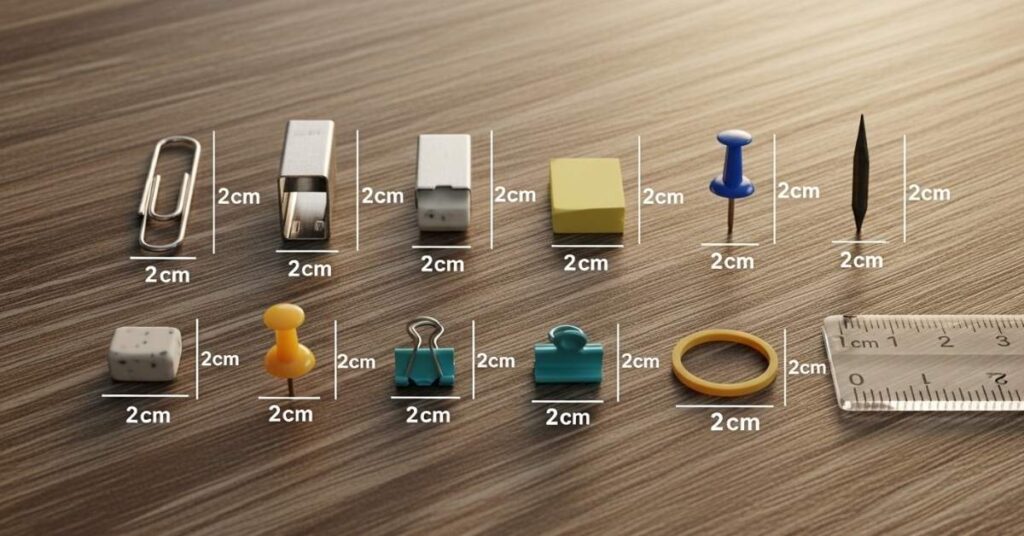
Walk over to your desk right now. Chances are you have at least three or four things within arm’s reach that measure right around 2 centimeters. The most classic example is a standard metal staple. When it comes fresh out of the strip, flat and unused, it measures almost exactly 2 cm across. Most people have held thousands of staples and never thought about their size for even a second.
Another trusty office staple (pun intended) is the binder clip. Not the large ones, but the small, everyday size you’d clip a few pages together with. The metal clamp portion runs about 2 cm in width. Paper clips also hover right around this range, depending on the brand and style. The standard gem clip is typically between 1.9 and 2.1 centimeters long.
Then there’s the tip of a ballpoint pen cap. Remove the cap from your pen right now and look at the clip tab on the side. That small rectangular piece that hooks onto your shirt pocket? Roughly 2 cm. These aren’t coincidences. Designers and manufacturers calibrate small tools to fit comfortably in human hands, and 2 cm sits right in that ergonomic sweet spot.
School Materials & Small Length Examples
Think back to your school days. Your pencil case was basically a treasure chest of 2 cm examples. The pink eraser at the top of a standard pencil is one of the most recognizable. It’s not exactly precise for every brand, but that little pink nub at the top sits right around 2 centimeters in length. Every student has bitten one off in frustration at some point.
A single crayon tip, when freshly sharpened, leaves about 2 cm of pointed wax. The hole in a standard ring binder is about 2 cm in diameter. Even the brass fastener brad used in school projects has a head that measures close to 2 cm across. These little details add up to a surprisingly rich classroom measurement example list.
Rulers themselves are marked in centimeters, so you’d think measuring 2 cm would be second nature for any student. But ask most adults to show you 2 cm with their fingers and they’ll pause and guess. Building this muscle memory early makes a real difference in everyday size estimation skills.
DIY Project & Home Improvement References
If you’re into home projects, 2 centimeters becomes a measurement you encounter constantly. Small finish nails used in trim work are often sold in lengths starting at 2 cm. Cabinet hardware screws, the small ones used to attach knobs and pulls, frequently measure 2 cm in total length. These aren’t glamorous facts, but they’re genuinely useful when you’re standing in a hardware store trying to remember what size you need.
Grout lines in tiling are often between 1 and 3 cm wide, with 2 cm being a common choice for larger tiles. If you’ve ever laid tile yourself, you know how often you stare at that gap and wonder if it looks right. A 2 cm spacer gives a clean, even look without swallowing too much visual space.
Wood dowels used for furniture joints often come in 2 cm diameters. So do many small corner brackets. Even the wall anchor for a lightweight picture hook is typically right around 2 centimeters long. Next time you’re doing a small repair around the house, take a moment to actually measure these pieces. You’ll find 2 cm popping up more than you ever expected.
Tech & Compact Design Marvels
Modern technology loves miniaturization. And 2 cm is a sweet spot in compact design. Think about a standard SIM card chip. The actual gold contact area on a nano or micro SIM card runs right around 2 centimeters in length. Billions of these tiny chips power smartphones around the world, each one barely the size of your thumbnail.
USB connector tips are another great example. The metal plug portion of a standard USB-A connector is approximately 2 cm long. You’ve plugged one in hundreds of times without realizing you were handling a 2 cm object. The same goes for the 3.5mm audio jack standard tip, which fits into that range when measuring the insertable shaft.
Microchips on circuit boards, SD card contacts, and small LED components also frequently fall into this 1.5 to 2 cm dimensional range. Compact design engineers work in millimeters and centimeters daily. To them, 2 cm isn’t small at all. It’s a perfectly workable canvas.
Music, Creativity & 2 cm Comparison Moments
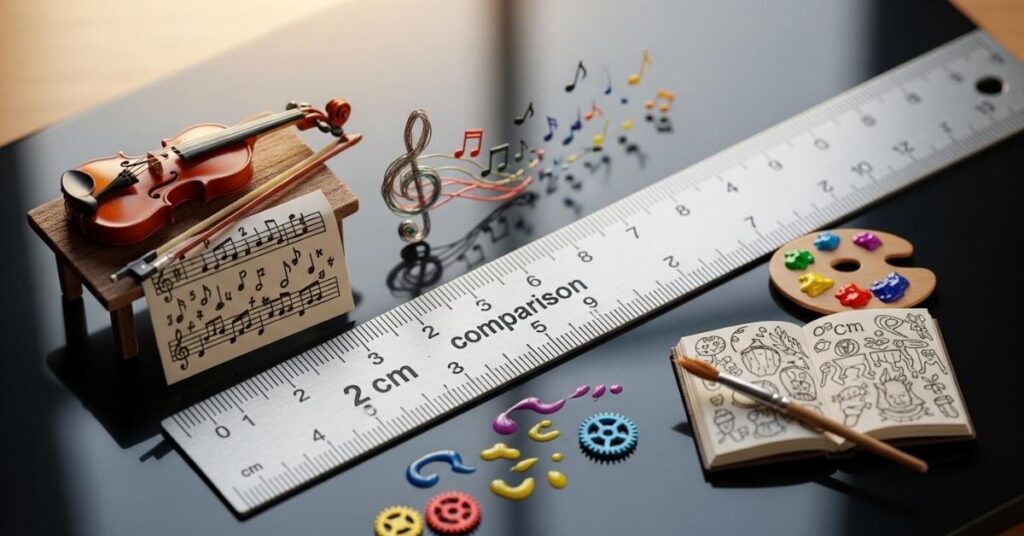
Musicians handle 2 cm objects more than they realize. A standard guitar pick, for example, is typically 2.5 to 3 cm long but the playing tip, the actual contact point with the string, is roughly 2 cm wide at its widest point. The distance between frets on a ukulele at the higher end of the neck? Right around 2 cm apart.
Artists and crafters work in this range constantly. A small watercolor brush used for fine detail work has bristles that span about 2 cm in length. Embroidery needles, the medium-sized variety, are typically 2 to 2.5 cm long. Even the clasp on a charm bracelet has a mechanism that fits within a 2 cm frame.
There’s something almost poetic about the way creativity demands precision at the smallest scale. A sculptor carving a miniature figure obsesses over 2 mm differences. A jeweler setting a stone works within fractions of a centimeter. These real world size examples remind us that small doesn’t mean insignificant.
Ancient Civilizations & Small Measurements
Long before the metric system existed, ancient civilizations had their own clever ways to handle small measurements. The Egyptians used the digit, which was the width of a finger, approximately 1.9 to 2 cm wide. It’s remarkable how close this natural unit sits to our modern centimeter.
The Romans used a unit called the digitus, also based on finger width, which measured almost exactly 1.85 cm. When you hold up your index finger and look at its width across the knuckle, you’re essentially looking at an ancient Roman unit of measurement. History and the human body have always been linked this way.
Even in ancient Asian measurement systems, small standardized units often landed in the 1.8 to 2.2 cm range. Rulers and calibrated weights from archaeological digs confirm that craftspeople across cultures independently arrived at similar small measurement standards. That’s not coincidence. It’s human anatomy expressing itself across thousands of years of history.
More Common Objects 2 cm Long
Let’s keep building that mental reference library. Here are more everyday items that hover right around 2 centimeters:
- A medium-sized shirt button is typically 2 cm across in diameter.
- A fresh blueberry, plump and round, measures about 1.5 to 2 cm wide.
- The cap on a tube of lip balm is usually 2 cm in diameter.
- A standard sugar cube measures approximately 2 cm on each side.
- The width of two stacked pennies is right around 2 cm.
- A human baby’s fingernail is almost exactly 2 cm wide at birth.
- The connector end of an Apple Lightning cable sits at about 2 cm wide.
- A single Lego brick with two studs in a row spans 2 cm across.
- A small birthday candle has a diameter of roughly 2 cm at the base.
- A pencil sharpener hole opening is usually about 2 cm in diameter.
Keep this list in your head. The next time someone asks you what does 2 cm look like, you’ll have a dozen answers ready without even thinking twice.
Why 2 Centimeters Matters More Than You Think
You might be wondering why we’re spending this much energy on such a small measurement. Fair question. But here’s the honest truth: precision at small scales separates good work from great work in almost every field.
In medicine, a tumor measured at 2 cm falls into a specific clinical stage. Whether it’s 1.9 cm or 2.1 cm changes the entire treatment approach. In cooking, a 2 cm dice for vegetables ensures even cooking time. In carpentry, a 2 cm margin of error can mean a drawer that sticks or a door that won’t close cleanly.
Even in everyday life, understanding small measurements makes you more capable and confident. You stop second-guessing yourself at the hardware store. You can eyeball fabric swatches without a tape measure. You can describe a physical symptom to your doctor with real accuracy. These are genuinely practical life skills wrapped up in a tiny, two-centimeter package.
How to Estimate 2 cm Without a Ruler
This is one of the most useful skills you can pick up. Learning how to measure 2 cm without a ruler sounds like a party trick, but it’s actually a practical everyday tool. Here’s what works best:
Your thumbnail is your best friend here. For most adults, the width of the thumbnail on your non-dominant hand is almost exactly 2 cm. Measure it once with a ruler and you’ll know for life. This becomes your built-in measurement device that you literally carry everywhere.
Another reliable method uses coins. In many countries, a standard coin diameter gives you a useful reference point. Stack two quarters (or two 10-cent coins in many currencies) flat against each other and the combined width is very close to 2 cm. It’s not lab-certified precision, but for everyday estimation, it works beautifully.
You can also use the tip of your index finger from the knuckle to the fingertip. For most people, this lands at roughly 2 to 2.5 cm. Once you calibrate this against an actual ruler, you’ll be able to estimate small lengths with surprising accuracy. Measurement without tools isn’t just guesswork. It’s trained intuition.
The Quiet Poetry of Small Measurements
There’s something genuinely beautiful about paying attention to small things. Most of us walk past 2 cm objects hundreds of times a day without a single conscious thought. The staple holding your documents together. The button keeping your shirt closed. The eraser tip you wore down during exam season.
These aren’t just objects. They’re measurements with purpose. Every tiny dimension was designed deliberately by an engineer or craftsperson who cared about getting it exactly right. Two centimeters didn’t happen by accident. It happened because it works.
When you start thinking this way about measurement, you develop a richer relationship with the physical world around you. You notice dimensions. You appreciate precision. You understand that small and insignificant are not the same thing. Not even close.
Frequently Asked Questions
What is 2 cm equal to in inches?
Two centimeters equals approximately 0.787 inches, which is just under 8/10 of an inch.
How can I estimate 2 cm without a ruler?
Use the width of your thumbnail as a reference. For most adults, it measures almost exactly 2 cm across.
Is 2 cm big or small?
It depends on context. In everyday terms, 2 cm is quite small, roughly the width of a thumbnail or a standard staple, but it’s medically and technically significant.
What everyday items are 2 cm wide?
Common examples include a shirt button, a sugar cube, a Lego two-stud row, and a standard paper clip.
How do I visualize 2 cm easily?
Picture the width of your thumbnail, a fresh blueberry, or the flat side of a standard staple. Any of these gives you an instant, reliable mental image.
Final Thoughts
Two centimeters is one of those measurements that rewards attention. Once you know what it looks like in real life, you’ll start spotting it everywhere. On your desk, in your kitchen, at the hardware store, on your own hand.
The goal was never just to give you a list of objects. It was to rewire the way you think about small measurements. Because understanding how big is 2 cm in real life is the first step toward becoming someone who sees the world with sharper, more calibrated eyes.
Carry your thumbnail. Trust your intuition. And the next time someone hands you a mystery object and asks how big it is, go ahead and surprise them.